
What We Used To Think of As Extreme
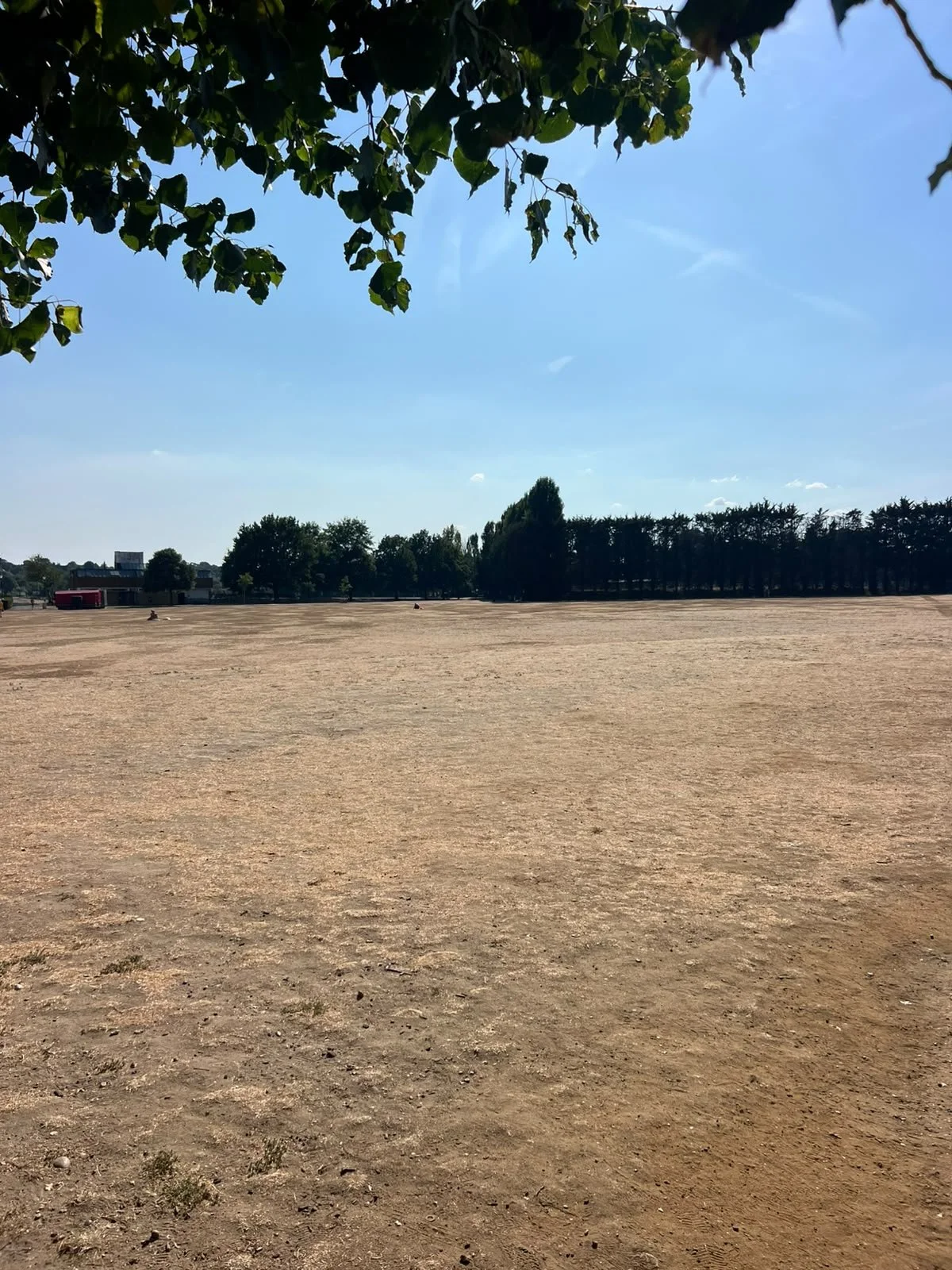
View of the Wimbledon Park grassland, UK from August 2026.
I returned to the UK last week to visit family, arriving from Dubai. What was meant to be a usual summer break at home produced instead a fairly disorienting sense of familiarity. I found myself performing a set of behaviours I associate entirely with the Gulf summers turned out to be the new norm in Surrey.
I took my eighteen month old daughter to the playground as usual but the metal slides were so heated in the middle of the day, sitting in direct sun, to a level that made her contact completely unsafe. If this was a few years earlier I wouldn’t have felt the need to check it with my hand before she reached the metal surface. This is not something British parents are used to thinking about in an ordinary summer.
I also noticed that the structure of the day itself had to change, with mid hours spent indoors and the outdoor time pushed into the evening. This is a habit I’m used to in Dubai, an arrangement in my schedule that I would make without noticing. However, to make the same arrangement in the UK was closer to watching two versions of my life overlap in a place where only one of them was supposed to apply
Then, on a separate occasion, there were the parks. The meadows and grassland around Wimbledon Park had lost their colour entirely, moving from shades of green to the pale brown of dry soil and spent vegetation across the visible ground.
The most striking moment of realisation came on the 14th of August, when my phone's emergency alert went off. It is a particular sound, a siren with a ten second vibration that overrides silent mode, and I recognised it straight away, which was not something I expected to happen in England. I had heard it several times before in Dubai, during missile alerts. In the UAE, it communicated a direct threat to our safety and wellbeing in a scenario of active war. The deja vu reached me before the message did. When it comes to these alerts, you react to the sound first and read the words afterwards, and the dread in between was identical.
The message here warned of a very high risk of wildfires nationally and told people not to light barbecues, firepits or fireworks, and the same day the government banned the sale of disposable barbecues outright. It was the most extensive use of the UK's emergency alert system for an active incident, and that is worth pausing on. An alert of that kind is the last layer of a resilience system. It is what a country reaches for once prevention has run out and the only move left is to ask millions of people to change their behaviour within the eleventh hour.
The threat we were warned about was a different one than the UAE. However, what it says about our safety is not. We are facing a direct threat to our personal safety here too, and it is something we (or the government) can no longer control.
None of these observations is dramatic on its own, and each could be dismissed as an unlucky fortnight. What makes them worth writing down is the underlying record, which no longer supports that reading. The Met Office's assessment of the UK climate, published in July, found 2025 to have been the warmest year in the national series, the sixth time that record has been set this century, with the most recent decade running 1.33°C warmer than the 1961 to 1990 baseline. Mike Kendon, its lead author, put the position in terms that resist softening “What we used to think of as extreme, we increasingly consider as normal”.
The more consequential finding concerns the shape of the distribution of such heatwaves as well. The extreme temperatures are moving faster than the average and the headline figures understate what is happening at the hot end. In south east England the hottest days of the year have warmed by 4.5°C, roughly three times the overall rate of warming. Kendon's summary describes a change inside a single lifetime, in that the UK rarely reached even 30°C anywhere during the twentieth century, and 35°C is now expected during summer heat spells.
Once I did a bit of research as a climate professional, I recognised the pattern which the mechanics of this particular summer follow. High pressure has sat near or over the UK with the jet stream dipping to the west, drawing warm air northwards and compressing it as it descends, which warms it further. What has distinguished 2026 is the moisture content of those air masses, which crossed the Atlantic and arrived carrying unusually high dew points. Humid heat is more dangerous than dry heat at the same temperature because it impairs evaporative cooling, which is the body's primary mechanism for shedding heat. A marine heatwave around the UK coastline, running 2°C above average and locally 4 to 5°C warmer, has also contributed to the heat further.
Night time extreme temperatures receive the least attention but they are when the physiological risk concentrates. Overnight minima have tracked at record levels this summer, with tropical nights above 20°C across southern England and Wales. Persistent warmth overnight prevents buildings from discharging the heat they absorb during the day and denies the body its recovery period, so successive hot days compound rather than reset. This is the main reason why heat becomes lethal during extended events.
Set against that background, the season reads differently. By the middle of July the UK had already recorded more days above 30°C than in the whole of 1976, and 2026 became the first year on record to reach 35°C in May, June and July. July was the driest in 190 years, delivering 10 per cent of expected rainfall, and by 10th of August the Environment Agency had placed 71.3 per cent of England formally in drought. Greater London received 0.2mm of rain across the whole of July, which explains the colour of those meadows.
What separates this summer from earlier hot ones is that its human cost has been quantified. A rapid attribution study published in July by Imperial College London, the Met Office and the London School of Hygiene and Tropical Medicine estimated around 553 excess deaths during the May heatwave and 2,183 during June, of which 59 per cent and 38 per cent respectively were attributable to human-caused warming, and found the events between three and seven times more likely than they would otherwise have been. One of its authors, Dr Clair Barnes, put the position without qualification, she says “we now live in a country with dangerously hot summers, and protecting people through future extremes requires adapting to the climate we actually have”.
The exposure to unsafe conditions that follows is not just meteorological either. British housing is designed to retain heat, and mechanical cooling remains uncommon in homes and largely absent from schools and public buildings. The House of Commons Library observed this month that the UK currently has no single overarching plan for adapting to heat or building resilience to it, while analysis cited by the Green Alliance puts 92 per cent of existing UK homes at risk of overheating by 2050 on present trends. A National Heat Risk Commission was established in March under Emma Howard Boyd, framing heat as a systemic hazard requiring a systemic response, which is the correct diagnosis arriving in the same year as the conditions.
Met Office research published last year puts the probability of the UK exceeding 40°C at more than twenty times its 1960s level, with an even chance of another such day within twelve years and the prospect of heatwaves lasting a month rather than the fortnight recorded in 1976.
I have found the professional dimension of this harder to write about than the personal one. Those of us working in climate and sustainability have spent a decade describing conditions like these in the future conditional, through projections, scenarios and risk registers. The tense has changed, and I am not convinced our institutional habits have changed with it.
The question I have not been able to resolve since returning concerns what my daughter will understand summer to be. She will not remember the season that unsettled me, and will absorb whatever summer turns out to consist of. In the UAE, the necessary adaptation was made deliberately and over decades, and it now sits in law, in building design and in social convention, with a midday break prohibiting outdoor work between half past twelve and three that has run for twenty two summers. However, the UK has arrived at a version of the heat without the surrounding architecture, and whether that architecture is built in time to become an unremarkable feature of her childhood, or arrives later and under more pressure, still remains open.
