
Sustainability in an Age of Geopolitical Tension: Insights from TCC’s Expert Panel
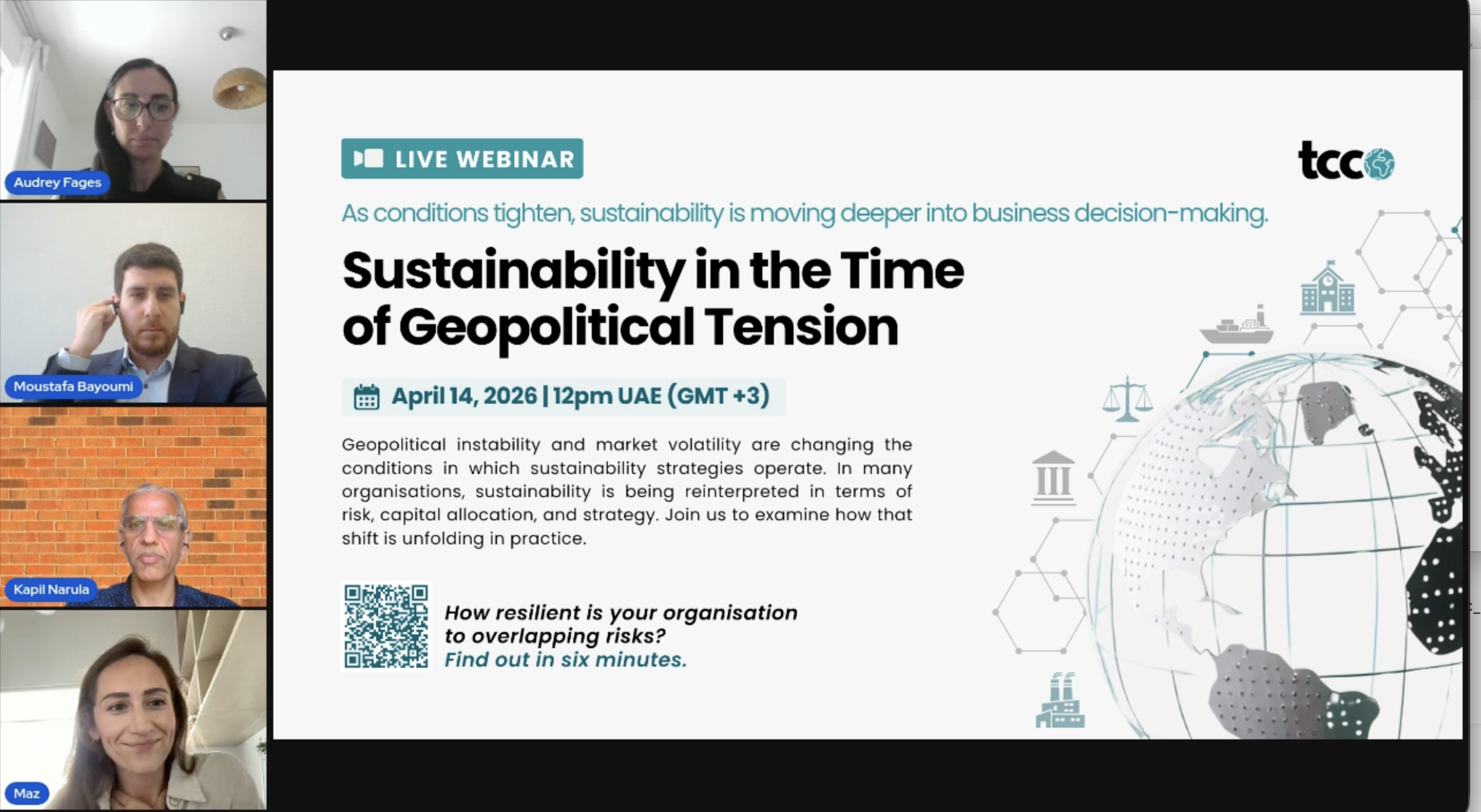
Geopolitical tension is no longer a backdrop to business strategy. It is the context in which the strategy is being made. From tariff escalations to supply chain disruptions and diverging regulatory regimes, organisations are navigating a world where volatility is structural, not cyclical. In this environment, sustainability is being tested, reframed, and in many cases, strengthened.
In TCC’s recent panel discussion, experts from diplomacy, climate policy, and corporate sustainability examined how these pressures are reshaping decision‑making across the Gulf and globally. Their perspectives reveal a landscape in flux, with real opportunity for organisations that can adapt quickly.
Energy Shocks Are Rewriting the Strategic Baseline
The conversation opened with the reality that energy markets have entered a period of sharp correction. Price spikes, supply disruptions, and policy divergence are forcing companies to reassess priorities in real time.
Panellists noted that while some discretionary sustainability spending is being paused, structural investments in energy efficiency, supply chain resilience, and operational optimisation are taking on greater urgency. The framing has shifted. These are now core components of energy security and business continuity.
For the UAE, this moment presents both challenge and opportunity. With one of the world’s lowest break‑even oil production costs, the country has fiscal space to continue investing in renewables and green infrastructure. Capital is already flowing into domestic transition projects that strengthen long‑term competitiveness.
Experts also highlighted that while short‑term shocks may temporarily slow renewable deployment, the medium‑term trajectory is clear: countries will double down on energy security, and renewables are central to that strategy.
Risk Is Becoming Non‑Linear, and Companies Must Catch Up
A major theme across the discussion was the growing complexity of climate‑related risk. Traditional corporate risk models, built on linear assumptions, are struggling to capture the compounding nature of physical and transition risks.
One expert pointed to a critical feedback loop in the Gulf: rising temperatures drive higher cooling demand, which increases energy consumption, which in turn accelerates warming. With cooling demand projected to triple by 2030 and hyperscale data centres expanding rapidly, the region’s energy trajectory may be significantly underestimated.
This is not just an environmental issue; it is a strategic one. Companies that fail to integrate these dynamics into their planning risk being blindsided by operational, financial, and regulatory shocks.
Another panellist emphasised that resilience, not sustainability alone, will become the defining metric for governments and companies. The question is shifting from “Is this sustainable?” to “Does this strengthen our ability to withstand disruption?”
Demand for Green Solutions Is Evolving, Not Declining
The panel explored how geopolitical tension is reshaping demand for green products and services. The consensus: demand is not disappearing, but it is diverging.
Key dynamics include:
Heavy industry in the GCC is accelerating decarbonisation due to industrial diversification strategies.
Consumers, facing cost pressures, may deprioritise green alternatives in the short term.
Mandatory decarbonisation sectors such as aviation, shipping, and heavy manufacturing will continue to drive demand regardless of market volatility.
The long‑term direction remains intact, but the pace and distribution of demand are shifting.
What Companies Should Prioritise Now?
Across the panel, a clear consensus emerged: resilience is the new baseline for sustainability strategy. Companies committed to sustainability and to remaining competitive should focus on:
Supply Chain Resilience: Identify single points of failure, diversify suppliers, and build redundancy. Supply chains are the most immediate vulnerability for many organisations.
Energy and Process Efficiency: Efficiency was described as the “first fuel”: a no-regret option with immediate ROI. In a high‑cost, high‑volatility environment, efficiency becomes a strategic asset.
Governance and Decision Agility: Companies need governance structures that enable rapid, informed decision-making. Slow governance is now a material risk.
Low- or No-CapEx Sustainability Actions: Even when large capital projects are paused, companies can maintain momentum through operational improvements, behavioural initiatives, and process optimisation.
Disciplined Transition Investment: Invest only in initiatives that strengthen long-term resilience and clear the bar of immediate commercial viability.
Signals to Watch in the Coming Months
The panel highlighted several indicators that will shape the sustainability landscape in the near term:
Renewable energy installation rates, especially where private sector investment fills public budget gaps
Electric vehicle adoption is influenced by oil prices and supply chain constraints
Policy clarity vs fragmentation, particularly as regulatory regimes diverge across regions
Actual corporate investment decisions, not just public commitments
Supply chain stabilisation, especially in energy, petrochemicals, and fertilisers
These signals will determine which organisations emerge as leaders and which fall behind.
The session closed with a clear message: sustainability is no longer a parallel agenda. It is embedded in risk, resilience, and long‑term competitiveness. The organisations that recognise this and adapt accordingly will be the ones that navigate volatility with confidence.
The organisations that will come out ahead are those that stopped treating sustainability as a separate lane. The conditions for disruption are also, for the well-prepared, the conditions for distinction.
You can watch the full recording on LinkedIn.
