
Innovation at the Edge of Biodiversity and Value
TCC recently hosted Carolina for a virtual coffee chat exploring her work and vision for shaping the future. The full recording will be available on our platform.
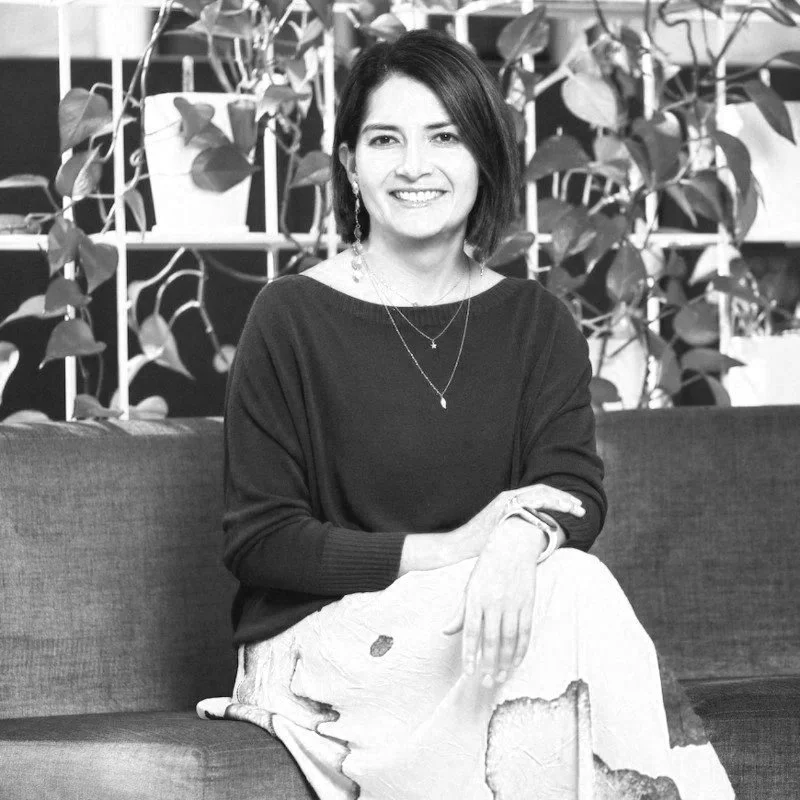
Carolina Proaño Castro
Carolina Proaño Castro is a climate and biodiversity strategist from Ecuador with nearly 20 years of experience helping leaders navigate climate risk, biodiversity loss, and the shifting landscape of long‑term value. She works at the intersection of foresight, futurism, and system‑level innovation, translating complexity into strategic choices for future‑fit leadership. As Executive Director of Fundación Futuro, she advances high‑integrity climate action and innovative financing, including NFTree, which channels climate contributions to Ecuador’s most biodiverse ecosystems and the smallholders often left out of traditional climate finance.
Q.1) What’s the current initiative that you’re working on the most related to biodiversity and the value of nature?
I currently work as the Executive Director of Fundación Futuro. It’s a private NGO based in Ecuador that is linked to a corporate group called Global Futuro. What we are implementing is, let’s say, a private carbon market where, instead of buying traditional carbon credits, you pay for conservation efforts. In the world of carbon, that would be called more like an insetting or a high‑integrity climate contribution with biodiversity impacts. What we do is work with 21 companies that have measured their emissions and have a plan for reduction, and in order to neutralise their emissions, they pay for conservation efforts in highly biodiverse areas in the country.
Q.2) How did that initiative come about?
It came about through a lot of ingredients coming together. The holding group's biggest shareholder is a conservationist by nature and has been working on these issues for a long time. So, despite being a businessman and a well-recognised public figure, he is a biodiversity leader. In Ecuador, we also had a regulatory framework that prevented us from participating in the traditional voluntary carbon market, while private reserves and national parks remained underfunded. We had to find a way to use what we had in our favour. Because it’s a holding group with 21 companies, we could work through corporate governance to set clear voluntary guidelines to ensure sufficient funding flows toward biodiversity efforts. At the same time, we joined with academia. Many studies end up in peer‑reviewed papers that nobody really uses, but with a local organisation and several universities in Ecuador, we’ve been developing a way of monitoring forests for 14 years. We now have enough scientifically proven ground data to know exactly how much carbon and biodiversity those forests capture, hold, or protect. On one side, we had the science; on the other, a business group that had to act because of corporate governance. The match was perfect. That’s how it came about.
Q.3) What inspired you to think about nature as something digital, traceable, and investable?
It really came from regulatory restrictions. Innovation usually comes because of restrictions. When I started running the organisation, I had been living and working in the UK for the Global South program, and regulatory frameworks everywhere are very different. To implement the Paris or Montreal Agreements, you need local guidelines. In Ecuador, we had maybe two decades of delay compared to Colombia or Peru. The traditional carbon market already had a bad reputation, double counting, a lack of traceability, questions about real measurement and Ecuador had no regulatory framework at all. So the digital traceability mechanism arose as a response. There was no carbon tax, no green taxonomy, no incentives, and we weren’t allowed to play in the traditional market. Yet we have some of the most biodiverse forests in the world, and they are underfunded. Technology came in handy. We created a platform with all the data. We developed models using artificial intelligence, machine learning, and some deep learning to predict how much carbon and biodiversity these forests hold, 195,000 hectares, peer‑reviewed and scientifically proven. These maps were amazing but unused except by certifiers. We put them into a blockchain platform that allows us to sell tokens. Companies measure their emissions, buy what they want, pay a token fee, and the money goes into a trust fund. The trust fund pays conservation agreements to the people and landowners doing the work. This gives us full financial and legal traceability, and we’re not selling anything that isn’t allowed; it’s simply exchanging a token for money. Because we’re an NGO and not making a profit, and because technology ensures traceability, we can provide 80% of the money directly to local landowners. Improving governance and building confidence came from creating something that worked within our restrictions.
Q.4) Has this mechanism helped you put a price on biodiversity loss, and is it changing how businesses make investment decisions?
Yes and no. We do have information about alpha biodiversity. Each token represents pixels in a forest, and those 10×10‑meter pixels contain data on carbon stock, productivity, and alpha biodiversity the number of species in a specific location. That already shows which areas have more or fewer species. Scientifically, we’ve figured that out, and not many programs have, because biodiversity is difficult to measure everywhere. On the business side, our companies are required to buy our token for corporate governance reasons. There isn’t a market‑driven need, and they’re not buying it because of biodiversity. They understand the philosophy, but from a business or risk‑management perspective, it’s not something they have to do. One company a major tourism company with high‑end ecolodges and three cruisers in the Galápagos depends directly on biodiversity, so it makes sense for them from a PR, branding, and risk‑management perspective. They’re happy the rest of the group invests in conservation. But for others, like the biggest insurance company in the country, there’s no direct dependency. They know biodiversity reduces long‑term risk, but it’s far removed in their supply chain, so it’s not an immediate business need. It’s not straightforward.
Q.5) Do you think this corporate‑governance‑driven participation is sustainable in the long term, and when do you expect a tipping point where more businesses recognise biodiversity as critical to their sustainability?
Well, we’ve already reached the limit of what we can do inside our corporate group. Outside of it, it’s very difficult to sell this because there’s no regulation forcing companies to act. The first thing that must happen is local legislation that is not voluntary. If it’s voluntary, it will happen very slowly, if at all. You also need market incentives, but insurance, banks, and international traders are not aligned with this. Even though there are signs of global regulation, geopolitically, this is not the moment for those signals to turn into real action, and that’s far from local decision‑making. Take Ecuador, for example, we export cocoa, coffee, palm oil, and banana products, which are central to international trade. The EU can say, ‘No banana will enter unless it is zero‑deforestation.’ That’s nice, but who pays for that? Making production biodiversity‑friendly won’t happen in the short term without clarity on costs. European consumers won’t pay a premium. The EU will face shortages, and Latin America will sell to China or India instead, where there are no such restrictions. That’s the reality of international trade. So even though these regulations aim to make biodiversity protection mandatory, if you double‑click on them, it’s not really the case. Producers in Ecuador would rather sell to the region or to China than pay for new EU regulations or certifications because there’s no premium price to cover those costs
Q.6) In your view, what needs to change for this kind of approach to become normalised globally?
I think we need to understand that this is a transition, and we use the word without really understanding what it means. Transition means everybody has to pay for it, and many enabling conditions must be met along the way. Under EU biodiversity regulations, what should happen but hasn’t is a phased transition with a clear timeline, where all stakeholders share the costs. Otherwise, it won’t happen. The idea that international law will automatically have a local impact is naïve. You may aspire to sell bananas to the EU, but if it becomes too expensive, you won’t because you don’t care about biodiversity, but because you can’t pay for the transition. Right now, the burden falls entirely on producers or biodiversity‑rich countries like Ecuador, where we face difficult trade‑offs. We are rich in biodiversity, critical minerals, and oil. On a small piece of land, you must choose: grow organic bananas for the EU, sell critical minerals, or extract oil. Mining and oil are easy; transitioning to biodiversity‑friendly production is hard because the incentives aren’t there. We have perverse incentives in oil and mining, and not the same level in agriculture or conservation. To fix this, we need to correct the incentives. For every $1 invested in conservation, $34 are spent harming biodiversity. It doesn’t matter if you invest $1 when $34 go to damaging it, usually through extractive industries or infrastructure. I’m not against those sectors, but the playing field is not fair.
Q.7) What do you think financial markets can do here, and how is your tool helping shift those incentives?
In the financial markets, small things are happening, but the big challenge is how you measure biodiversity. There’s an appetite for risk, but we’ve been developing carbon markets for 50 years, and they’re still not fully working. Biodiversity is even more difficult. What’s more valuable: an Asian bear, a grey bear, or an elephant? How do you compare one butterfly to another? That complexity scares the finance world. They’ve taken steps like debt‑for‑nature swaps, but when they don’t know how to measure impact, it becomes tricky. The money is there, or could be there, but measuring biodiversity impact is the challenge. That’s where we’re trying to help. Our methodology gives some clarity, and we’re slowly getting closer. British banks are now hiring biodiversity experts, something that never happened before. My suggestion is to be more pragmatic. Don’t fall into very technical measurements like carbon. In conservation, if you protect the land and stop land‑use change, that’s already good enough. Whatever lives there, frogs, butterflies, anything will be fine. Nature knows what to do if you stop harming it. You don’t need exact species counts; you just need clear no‑go zones and areas for sustainable use. We already have those methodologies globally.
Q.8) Has COP30, being hosted in Brazil with the Amazon at the centre of global attention, changed the conversation around nature and biodiversity in any meaningful way?
Yes and no. The good thing about Belém was that, for the first time, the two COP’s, the COP for Nature and the COP for Climate, came together. For me, that was long overdue. Until now, the climate agenda has been threatening the biodiversity agenda, especially due to mining for critical minerals for the energy transition. We were trying to transition our energy systems while mining the most biodiverse areas in the world, even the ocean. It was a disaster, and the two COPs were discussing in parallel. This time, the two agendas finally came together and addressed those trade‑offs: We want an energy transition, but at what cost? Do we need mining? Yes. But where can we mine, where can’t we, and why? It’s an agenda of resilience, and this was the first time that conversation happened. But COP’s reflect geopolitics, and we are in the worst moment for geopolitics, multilateralism, and international law. That makes it very hard to enforce any treaty. If China and the US, the big polluters, aren’t on board, nothing moves. Equador can do everything it can, but we are too small to change the global course. Without the US and China, those negotiations are useless at the global level.
Q.9) Do you feel the recent shift in direction from the US has slowed momentum around this work, or are you seeing companies reinvest and double down despite that?
Yes and no. What we’re seeing now is that political shifts in the US change the narrative to their own benefit. My lesson from that is: we need to work domestically and do whatever we can where we are. Those international scenarios or conditions are out of our hands, and we have to navigate them, but we still need to finance nature. We still need to find ways to finance it. When you innovate at the local or national level, you’re more likely to succeed than if you try to innovate at the global level. Even if it doesn’t scale, it’s already saving enough land. But things will get trickier depending on each economy, and how dependent it is on the US; some will be affected more, some less. In Ecuador, I haven’t seen companies outside our corporate group saying, ‘Because of the US, let’s invest more in this.’ We have other problems which are much bigger to deal with than biodiversity.
Q. 10) With so many urgent issues competing for attention, how do we bring the conversation back to nature, especially for people who feel disconnected from it?
I think we need to mainstream the conversation into risk management and resilience. That’s it. You don’t need to talk about a beautiful frog or a beautiful animal; it’s about resilience, water, soil fertility, pollination, and food security. If you frame biodiversity as a security issue, it will stay on the agenda, and that’s possible. People working in biodiversity should stop talking about how beautiful it is and start showing that without it, there is more risk, less food, and less water. And that’s true, we’re not inventing anything. That would be my suggestion. For at least the next five years, the same applies to sustainability. We will have to stop using those big headline words, but we still need to move the agenda forward using different language and making sure we’re at the table with other stakeholders.
Q.11) Which sectors and regions do you see as most at risk from nature‑related impacts, beyond Ecuador?
Latin America for sure, not just Ecuador. The whole region is at risk. We hold 53% of the world’s forests and 43% of global terrestrial biodiversity, so any disruption has global consequences. Southeast Asia is another hotspot, and many biodiverse regions sit atop critical minerals, creating pressure for extraction. Parts of Africa face similar dynamics. But nature has value everywhere, not only in biodiversity‑rich countries. It’s important to distinguish between biodiversity and ecosystem functioning. Biodiversity refers to the species in a place, while ecosystem functioning, soil health, water production, and pollination are essential everywhere, even in regions with fewer species. Soil and water are the ecosystem functions the world most urgently needs to maintain. So while Latin America, Southeast Asia, and parts of Africa are the most exposed, nature‑related risks are global. Every region depends on functioning ecosystems, whether or not they are biodiversity hotspots
Q.12) How do we bridge the gap between companies in Ecuador and companies operating far away, so they understand how interconnected these places really are?
It really comes down to how ecosystems function. Every human being has the same basic needs: nutritious food, clean water, and healthy soil. Water scarcity is already a reality everywhere, even in regions like Latin America that are considered water‑rich. Cities like Mexico City and Santiago are already facing severe shortages. So the way to unite different regions isn’t by focusing on ecosystem uniqueness, but on what we all need to survive. Clean air, clean water, and fertile soils are the bare minimum. A landscape can be a rainforest or a desert, but you still need food and water to live. That’s the conversation that creates a real nexus between regions. It’s also a national security issue. If a country doesn’t have water, it will go to war for it. The same is true for food and energy. Those three elements, water, food, and energy, are what make nature a primary need in every political agenda. If we can frame nature in those terms, we win.
